How Much Does Land Clearing Cost Per Acre in Texas? A Hill Country Breakdown

Land clearing in Texas Hill Country costs between $1,500 and $6,000 per acre for most residential and small-acreage projects, with forestry mulching on cedar-heavy lots typically landing in the $2,000–$4,500 range. The wide spread isn’t a pricing mystery — it comes down to what’s on your land, how thick it is, and what sits underneath. This guide walks through every factor that moves your number up or down, and one program that could put up to $6,000 back in your pocket.

Before anything else: any contractor quoting a firm per-acre price over the phone without seeing your property is guessing. Dense cedar on a rocky slope costs more than scattered brush on flat ground, even if both properties are exactly one acre. The walkthrough is where the real quote begins. For a full overview of land clearing methods, equipment, and what to expect from start to finish, see our complete guide to land clearing in Texas.

The Biggest Cost Driver: What’s Actually Growing on Your Property

Vegetation type and density move the price more than any other single factor. This is especially true in the Hill Country, where Ashe juniper (cedar) and mesquite don’t grow evenly across a property. You can have open pasture on one end and an impenetrable cedar thicket on the other — and those two sections will be priced differently even though they’re on the same tract.

Here’s how vegetation density typically breaks out into rough cost ranges for Hill Country properties:

Vegetation TypeTypical Range Per Acre
Light brush, scattered cedar under 4″ diameter$1,500 – $2,500
Medium cedar stands, mixed brush, some hardwood$2,500 – $4,000
Dense cedar thickets, large mesquite, mature hardwood$4,000 – $6,000+

Pro Tip: Satellite images and drone photos aren’t a reliable substitute for a ground-level walkthrough. Cedar can triple in apparent density once you’re standing in it versus looking at it from above. Contractors who quote remotely are pricing based on the best-case version of your property.

The Six Factors That Shape Your Quote

1. Tree Size and Diameter

Larger trees take longer to process, regardless of method. A drum mulcher cuts through four-inch cedar fast. A twelve-inch post oak slows everything down. If your property has a mix of tree sizes, the larger specimens push your cost toward the higher end of your vegetation tier.

2. Terrain and Slope

Flat ground is fast ground. Hill Country properties with significant slope add time — equipment takes longer to reposition, access angles are trickier, and operators have to move more carefully to avoid machine rollover risk on steep ground. Expect a slope surcharge on any property with more than a moderate grade across the clearing area.

3. Caliche and Surface Rock

A lot of Hill Country soil sits on caliche, a hard calcium carbonate layer that affects how equipment moves across the property. It doesn’t always cause problems for clearing, but when a property has shallow caliche combined with embedded surface rock, it slows machine movement and sometimes limits what equipment can access. If you’re planning to follow clearing with build site preparation or grading, caliche is a factor worth discussing before work begins.

4. Acreage and Mobilization

Equipment mobilization — moving machinery to your site — is a fixed cost regardless of project size. On a large tract, that cost spreads across more acreage and shrinks the per-acre impact. On a half-acre lot, mobilization can add meaningfully to the effective per-acre rate. This is why small residential lots often cost more per acre than larger ranches, even when the vegetation is comparable.

5. Clearing Method

The method chosen changes both the cost structure and what you get when the work is done.

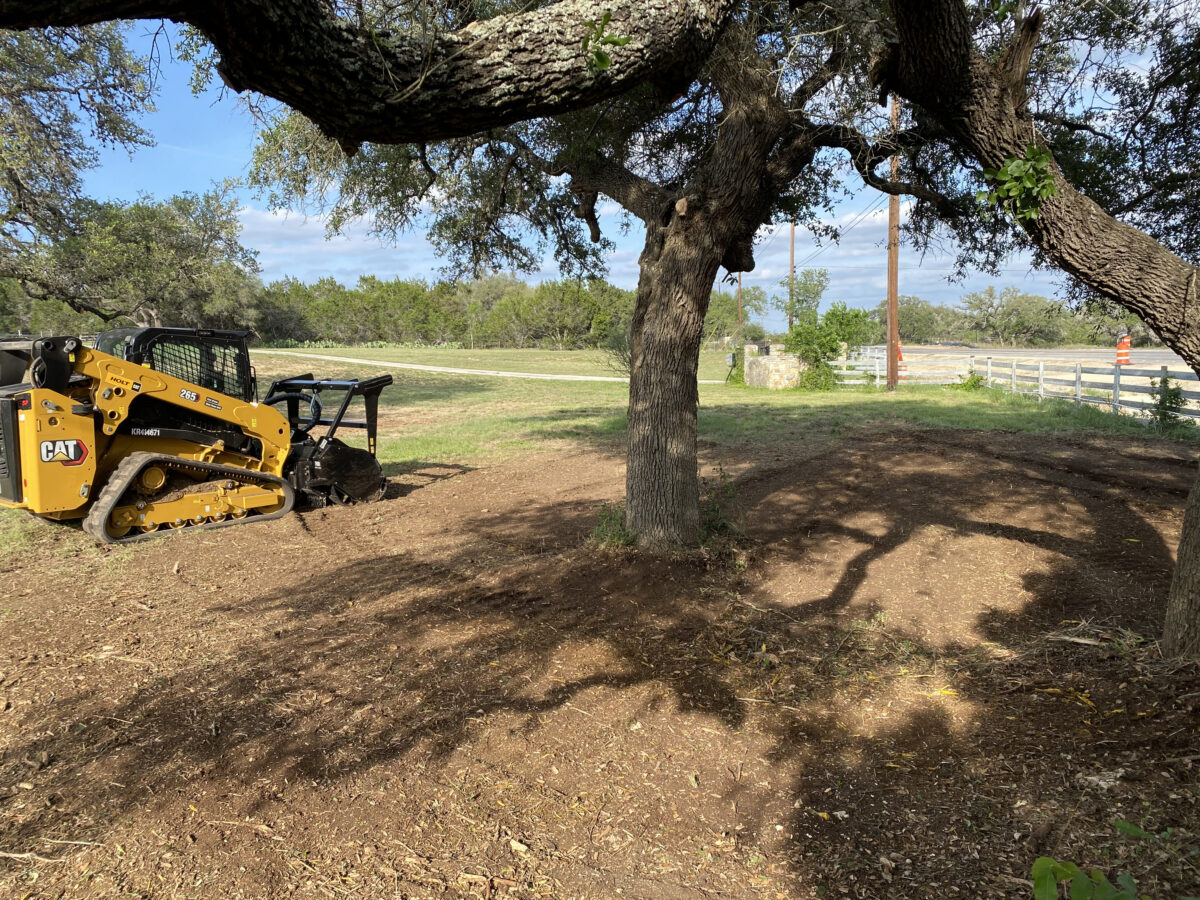
  • Forestry mulching — one machine grinds everything in place, no haul-off, mulch stays on the ground. This is what we use at The Mulching Marine. It’s efficient on cedar and brush, gentle on soil structure, and leaves no burn pile or haul-off to manage.
  • Bulldozer clearing — faster on extremely dense timber, but it strips topsoil, leaves stumps, and requires a second step to manage the debris pile. Generally a better fit for large-scale commercial clearing where raw speed matters more than soil health.
  • Hand clearing — used for selective work, precise trimming around trees you want to preserve, and cleanup in tight spots. Slower and more expensive per hour but precise.

According to Texas A&M AgriLife Extension’s brush management guidance, the right method depends on vegetation type, density, and what the land will be used for afterward — there’s no one-size-fits-all approach.

6. Debris Disposal

This cost often surprises first-time landowners. With forestry mulching, there’s no debris to remove — vegetation is ground into mulch on-site and stays there. With dozer or hand clearing, someone has to deal with the piles. Hauling and dump fees, or pile burning (where permitted), add meaningfully to the total project cost. When comparing quotes between methods, make sure you’re comparing apples to apples on what’s included.

What Changes After You Clear: Costs That Come Next

Land clearing is typically step one, not the whole project. What comes after clearing affects what clearing method makes sense and sometimes what the clearing itself should look like.

Building a home or structure? Clearing should leave the ground in a condition that works for the build site preparation that follows — grading, compaction, and foundation work all start from what clearing leaves behind. Forestry mulching‘s low soil disturbance makes it easier to grade afterward than dozer work, which can leave uneven terrain and buried root masses.

Establishing trails, driveways, or firebreaks? Clearing for access routes often goes hand-in-hand with firebreak and trail preparation — shaping the cleared path so equipment, vehicles, or livestock can move through it cleanly.

Expanding pasture? After clearing, you may want to seed native grasses. The mulch layer left by forestry mulching actually helps here — it slows erosion while the grass establishes and retains moisture during dry spells.

A Grant That Can Cover Up to $6,000

Here’s the number that changes the math for a lot of Hill Country landowners right now. The Texas A&M Forest Service Mechanical Fuel Reduction Grant reimburses qualifying landowners up to $2,000 per acre for forestry mulching work targeting cedar and heavy underbrush, capped at $6,000 per property.

To qualify, your property generally needs at least one acre of heavy fuel-load brush or cedar and needs to be located inside or adjacent to a recognized wildfire risk area. Qualifying counties include Comal, Hays, Blanco, Travis, Burnet, and approximately 39 others across the Hill Country and surrounding regions.

We’re a certified grant-ready contractor, which means our equipment and process already meet the grant’s inspection requirements. You can review the full eligibility criteria directly on the Texas A&M Forest Service Mechanical Fuel Reduction Grant page. If you’ve been holding off on clearing because of cost, the forestry grant page on our site has details on eligibility and how to start an application. The current window runs through July 14, 2026.

Did You Know? The Mechanical Fuel Reduction Grant prioritizes mechanical clearing over burning specifically because forestry mulching eliminates smoke, fire spread risk, and debris management — all issues that come with traditional pile burns on Hill Country properties.

How to Get an Accurate Quote for Your Property

No pricing guide replaces a walkthrough. Here’s what to have ready before a contractor visits your property:

  • Know your approximate acreage and which sections you want cleared
  • Walk the densest areas yourself and note where cedar is thickest or trees are largest
  • Know what you plan to do with the land after clearing — this shapes how the work gets done
  • Note any trees you want preserved, especially mature oaks or pecans
  • Check whether you’re in a county with local tree removal ordinances before work starts

Did You Know? Clearing a property selectively — removing invasive cedar and mesquite while preserving mature oaks and pecans — often takes more care and slightly more time than clearing everything, but many Hill Country landowners prefer it. Those preserved trees add real property value and take decades to replace.

Frequently Asked Questions

What does land clearing cost per acre in the Texas Hill Country? 

Most Hill Country clearing projects run between $1,500 and $6,000 per acre depending on cedar density, tree size, slope, and clearing method. Light brush clears on the lower end; dense cedar thickets with large trees push toward $6,000 or more. A site walkthrough is the only reliable way to get an accurate number for your specific property.

Is land clearing cheaper per acre on bigger properties? 

Often yes, because equipment mobilization costs get spread across more acreage. A contractor moving a machine to your site pays the same transportation cost whether the project is one acre or ten. Larger projects typically see a lower effective per-acre rate once that fixed cost is diluted across the full scope.

Does forestry mulching cost more than bulldozer clearing?

The machine rates can be similar, but forestry mulching eliminates the follow-up costs of pile burning or debris hauling. On most Hill Country residential jobs, the all-in cost of mulching is competitive with or lower than dozer work once disposal is factored in, with the added benefit of less soil disturbance.

What should I watch for when getting land clearing quotes in Texas? 

Be cautious of any contractor providing a firm per-acre price without visiting the property. Ask specifically whether the quote includes debris disposal, what method they’re using, and whether equipment mobilization is included. Compare quotes on the same scope — not all quotes cover the same work.

Can I use the Texas A&M Forest Service grant for a partial property clearing? 

The grant is designed for fuel reduction, so the work needs to meet the program’s criteria around brush density and wildfire risk. Contact us directly and we can walk you through whether your property and scope qualify before you go through the application process.